Showing posts with label news. Show all posts

Saturday, 6 February 2021

Growing list of billion-dollar crypto ‘unicorns’ recommend the best is yet to come

Growing list of billion-dollar crypto ‘unicorns’ recommend the best is yet to come

In the traditional investing world ‘unicorn’ is a term used by venture capitalists to describe a privately held startup valued at more than $1 billion. 

Typically these startups have strong fundamentals and oftentimes a first-mover advantage that helps them rapidly rise in value to become prized investment opportunities for yield-seeking funds.

Some of the best-known unicorns include Elon Musk’s SpaceX, a private rocket and spacecraft manufacturer with a valuation of $46 billion, and Coinbase, the largest U.S.-based cryptocurrency exchange with a current valuation of $8 billion.

While the world’s attention has been focused on the Coronavirus pandemic, the outcome of the 2020 U.S. presidential election, and the recent r/Wallstreetbets social investing phenomenon, the crypto sector has quietly ascended to a total valuation of over $1.2 trillion.

Adding to this, currently there are more than 55 unicorn status projects that have a market cap over $1 billion.


Top 18 projects by market cap. Source: Messari

Recent Bitcoin (BTC) evangelism from the likes of Michael Saylor, Mark Cuban and Elon Musk are helping shine a spotlight on the nascent crypto industry, and with it comes the discerning eye of institutional investors who will quickly want to look beyond BTC to what other promising opportunities exist in the space.

These projects are no longer just focused on making cryptocurrency a global means of exchange. Some of the top projects include smart contract platforms, decentralized finance (DeFi) protocols, privacy tokens, oracles providers and even humor-oriented meme coins.

With that in mind, here are some of the top crypto unicorn projects to keep an eye on as institutions begin to make their presence felt in the cryptocurrency markets.

Blue-chip projects

Bitcoin is the ultimate first-mover in the crypto space as it paved the way for the rest to come into existence and holds more than 61% of the total market value with a current market cap of $843 billion.

As the longest-running chain possessing the strongest mining network of all proof-of-work cryptocurrencies, BTC is likely to be the go-to choice for new money coming into the sector which will take a cautious approach to start out with.


Percentage of total market cap. Source: CoinMarketCap

Similar to how many of the current crypto faithful got involved in the space, Bitcoin will be the “gateway coin” that introduces the concept and leads to further exploration.

Ethereum (ETH), with a current market cap of $196 billion, is the obvious second choice as it is the most-utilized smart contract platform and home to a majority of the top DeFi protocols that have surged in popularity in recent months.

Other legacy projects that have survived multiple bull-bear cycles and achieved unicorn status include Litecoin (LTC), which has emerged as a reliable value transfer alternative to the higher fees and longer block times of BTC, and the privacy-focused Monero (XMR) and Zcash (ZEC), which paved the way in bringing anonymity to blockchain transactions.

These projects currently have market caps of $10.5 billion, $2.75 billion and $1.07 billion respectively.

Decentralized finance takes center stage

Since early 2020, one of the main driving forces in the growth of the cryptocurrency sector has been the emergence of decentralized finance.

Decentralized exchanges (DEX) like Uniswap have steadily grown from being a simple exchange interface dApp to a sprawling trading platform that now averages a 7-day trading volume of $6.72 billion, a figure that rivals volume of the top centralized exchanges.


Uniswap 7-day trading volume. Source: Uniswap

Uniswap’s UNI governance token was initially airdropped to users of the interface who took a chance on the protocol while it was still in development, but now the token can be found on all major centralized and decentralized exchanges.

The protocol also received venture capital backing to ensure further development. With a current market cap of $5.9 billion and a token price of $19.79, Uniswap is likely to be on the watchlist for the smart money eyeing the space.

SushiSwap, the main competitor to Uniswap, has also achieved unicorn status with a current valuation of $1.8 billion. The platform offers a community-focused system that allows token holders to stake their SUSHI to participate in governance as well as earn passive income from trading fees generated by the protocol.


Total value locked in DeFi. Source: Defi Pulse

While DEXs helped facilitate the growth of DeFi, lending protocols have emerged as the top draw for total value locked (TVL) and higher token values.

Maker (MKR), AAVE and Compound (COMP) are the leading platforms when measured by the total value locked (TVL) in the protocol. Currently there is a combined $15.63 billion in value deposited in smart contracts that interact with the protocols and their market caps range from $2.1 billion to $5.98 billion.

In addition to the high yield opportunities offered by staking protocols, retail investors are also attracted to the governance features that give token holders a say in the future development of the protocol. These DeFi darlings are likely to pique the interest of long term capital.

Ethereum congestion drives smart contract innovation

Ethereum’s dominance in DeFi has proven to be a double-edged sword as increasing network congestion resulted in an untenable surge in gas fees.


Average Ethereum gas price. Source: Etherscan

The recent record-high gas fees have opened the door for other smart contract platforms to fill the need for layer-2 options, as well as highlighting the need for oracle providers that can communicate data securely across platforms.

Promising smart contract platforms that have emerged include Polkadot (DOT) and its sister chain Kusama (KSM), which introduce interoperability with Ethereum and other top blockchains as the solution to the current siloed nature of separate networks.

DOT’s market cap has risen to $18.8 billion as its prominence continues to grow and Kusama is new to the unicorn club as its market cap just surpassed the $1 billion mark for the first time on Feb. 6.

Interestingly, Cardano (ADA), one of the 2017 ICO-era projects, has also started gaining momentum in recent weeks following the addition of smart contracts to the protocol and hints of future DeFi related endeavors.

Currently, Cardano’s market cap is $19.8 billion and the integration of DeFi could help propel its value higher as ADA has yet to tap into the liquidity offered on decentralized exchanges.

Theta captured the first-mover advantage when it comes to blockchain-based video streaming and the project has recently added smart contract functionality, the ability to create non-fungible tokens, and they launched the Thetaswap DEX on Feb. 4.

Oracles join the party

As more participants enter the crypto space and new blockchains emerge to fit specific niches, communication between separate networks will become essential to the overall health and continued growth of the sector.

This is where oracle projects come in to offer reliable, secure ways to transfer data.


Top oracle projects. Source: CoinGecko

Chainlink (LINK) is the top oracle project in terms of protocol integrations and its valuation. LINK currently has a $10.37 billion market cap and the project’s recent integration with Kraken exchange is expected to add further value to the project.

Meanwhile, upstarts like UMA and The Graph (GRT) have only recently achieved unicorn status as the 2021 bull market heats up. Both projects have developed novel ways to track, record and transmit data and they have reached valuations of $1.7 billion and $1.1 billion.

GRT has been especially active in the growth department, announcing multiple partnerships and upcoming integrations including bridges to DOT and Binance Coin (BNB).

The ‘unicorn’ herd will expand

Bitcoin burst onto the financial scene more than twelve years ago and has steadily forged a path to prominence that governments and the global financial system can no longer ignore.

Now that institutions are finally beginning to dip their toes into BTC and ETH, it’s time to take an even closer look at what the emerging blockchain ecosystem has to offer.

The herd of unicorns is likely to expand and considering that the decentralized finance sector is still in a very early growth stage, there’s plenty of value to be found in these unicorn projects.

com. Every investment and trading move involves risk, you should conduct your own research when making a decision.

Title: Growing list of billion-dollar crypto ‘unicorns’ suggest the best is yet to come
Sourced From: cointelegraph.com/news/growing-list-of-billion-dollar-crypto-unicorns-suggest-the-best-is-yet-to-come
Published Date: Sat, 06 Feb 2021 23:16:30 +0000

2021's Most Anticipated Growth & Wealth-Building Opportunity

Join Thousands of Early Adopters Just Like You Who Want to Grow Capital and Truly Understand Cryptocurrency Together


Growing list of billion-dollar crypto ‘unicorns’ recommend the best is yet to come
Check out the latest news at NewsWireUnited.com

Friday, 5 February 2021

After Yearn exploit, attacker funds frozen and repayment strategies developing

After Yearn exploit, attacker funds frozen and repayment strategies developing

Following an exploit last night that cost yield vault project Yearn.finance $11 million in stablecoin DAI, crypto community members from multiple projects have rallied to mitigate the effects, reclaim exploited funds, and reimburse affected users. 

First reported by the project at 5:09 pm EST, the exploit was a complex arbitration attack on Yearn’s version 1 DAI yield vault. According to a disclosure published by Yearn this morning, the exploit — which featured over 160 nested transactions and has been called one of the most complex to date — netted the attacker $2.7 million in profits, and cost the vault $11 million in DAI.

But, much like how Yearn core contributors are often among those who convene in the wake of other projects experiencing exploits, the crypto community is stepping in to help.

Shortly after the vulnerability disclosure, stablecoin Tether CTO Paolo Ardoino announced in a Tweet that the company had frozen $1.7 million in stolen funds, which will presumably be returned to the project.

. @Tether_to just froze 1.7M USDt stolen as part of the hack of Yearn DAI v1 vault.
More info here https://t.co/MjGScEucQB

— Paolo Ardoino (@paoloardoino) February 5, 2021

Likewise, senior Yearn core developer Banteg has informally proposed to the MakerDAO community the creation of a purpose-built collateralized debt position (CDP) to make affected users whole. 

If the proposal moves forward, the CDP will be funded from the 6666 YFI tokens that were minted this morning after a rancorous debate about the creation of a Yearn treasury.

“We are contemplating opening a cdp with the minted yfi to make the vault whole,” Banteg wrote in the MakerDAO chat shortly after the exploit last night. “Share price can be reverted back by airdropping 11m dai to it.”

In a statement to Cointelegraph, semi-anonymous core contributor Tracheopteryx noted that the proposal is one among many “initial ideas,” and that “nothing has been decided yet.”

“Many people in our community are brainstorming potential responses to the 11M yDAI vault exploit last night […] One option is to open a new CDP at Maker for YFI, deposit some of our newly minted tokens, mint DAI, then pay that DAI into the yDAI vault. After this we could pay off the debt over time from fees,” he said.

So far, the MakerDAO community seems to back the idea. An informal poll shows 93% support for the creation of a CDP from 28 voters. Likewise, commentators in MakerDAO’s chat noted the potential marketing benefits of stepping in to assist another DAO, as well as the historic nature of such a proposal.

The historical implication seemed to particularly excite Banteg:

“daos bailing out daos is the future we deserve.”Title: After Yearn exploit, attacker funds frozen and reimbursement plans developing
Sourced From: cointelegraph.com/news/after-yearn-exploit-attacker-funds-frozen-and-reimbursement-plans-developing
Published Date: Fri, 05 Feb 2021 15:49:08 +0000

Did you miss our previous article…
https://www.newswireunited.com/wallstreetbets-vs-wall-street-a-prelude-to-defi-rupturing-onto-the-scene/

2021's Most Anticipated Growth & Wealth-Building Opportunity

Join Thousands of Early Adopters Just Like You Who Want to Grow Capital and Truly Understand Cryptocurrency Together


After Yearn exploit, attacker funds frozen and repayment strategies developing
Check out the latest news at NewsWireUnited.com

Wallstreetbets vs. Wall Street: A prelude to DeFi rupturing onto the scene?

Wallstreetbets vs. Wall Street: A prelude to DeFi rupturing onto the scene?

Was last week’s Reddit versus Wall Street stand-off really the “beginning of the end for centralized finance,” as Gemini founder Tyler Winklevoss described it? Or was it just a one-time instance of individuals coming together to right a perceived wrong — with no long-term economic consequences?

As GameStop, a struggling videogame retailer, came under attack by hedge-fund short sellers, a coalition of individuals spearheaded by r/Wallstreetbets, a Reddit forum, jumped in to save GameStop by buying its shares, driving its stock price from $20 to as high as $483 — and doing some real damage to short traders in the bargain.

But then Robinhood, the insurgents’ trading platform of choice, suspended purchases of GameStop’s GME stock and seven other stocks. The Redditors cried foul, asserting that Robinhood had caved in to the hedge funds and other entrenched Wall Street interests. Robinhood, for its part, explained that it was forced to suspend GME purchases or it would have run out of cash to cover the transactions.

However, more than 30 class-action lawsuits were filed against the centralized trading platform — one complaint arguing that the suspension was just what “the [GME-shorting] hedge funds wanted,” and another even declaring that “Robinhood stole from the poor to give to the rich.”

Others implied that this sort of chicanery wouldn’t have occurred in a decentralized financial world. Along those lines, Galaxy Digital’s Mike Novogratz called the GME flare-up a “giant endorsement of DEFI,” and one crypto user, who wanted to remain anonymous, told Cointelegraph: “Restricting individuals from buying a selected stock is a form of a centralized control mechanism. In a decentralized trading market, no one would have that power.”

This view wasn’t unanimous, though. Quantum Economics co-founder Mati Greenspan found little to applaud in the crowd-sourced purchasing of GameStop stock: “The narrative that Main Street was finally able to beat Wall Street at its own game is extremely misguided,” as according to him, “there were hedge funds on both sides of this trade.” He went on to add: “It’s hard to see how buying overpriced shares of a company that’s losing money will make the world a better place.”

With that as a backdrop, here’s a deeper dive into what lessons, if any, could be drawn from the r/Wallstreetbets vs. the suits showdown. For instance, if retail investors can now move stock prices, then surely they can move large-cap cryptocurrency prices, no?

Is the writing on the wall?

“The events around GME and Robinhood were a wakeup call for the broader public,” Alexei Zamyatin, co-founder and CEO at Interlay — a research and development company focusing on blockchain interoperability — told Cointelegraph, adding: “I doubt most people outside of finance/banking were aware that Robinhood’s main customers were hedge funds rather than retail users.”

“I’m not entirely sure I agree that the recent GME saga has proven that retail investors can meaningfully coordinate to move stocks in the long run,” George Giaglis, executive director at the Institute for the Future at the University of Nicosia, told Cointelegraph. “I see this more as evidence of late-stage market-topping rather than a new wave of sustainable retail-driven market domination as many commenters would like to portray it,” he added.

Kaj Burchardi, head of BCG Platinion Netherlands — a division of Boston Consulting Group — told Cointelegraph: “In theory, a joint retail crowd can move many assets,” including crypto prices — but of course, that depends on the size of the crowd. The Reddit r/Wallstreetbets forum reportedly mobilized thousands of individual investors to purchase GameStop shares. “Overall, I think the number of retail investors will grow in the crypto space — independent if they join forces similar to the GameStop example,” said Burchardi.

Historically, retail investors — not institutions — have driven crypto prices, Lex Sokolin, chief marketing officer and global fintech co-head at ConsenSys, told Cointelegraph, adding:

“Their risk tolerance has been higher, and the crypto narrative appeals more to individuals looking for a new system. DeFi put retail and institutional capital on level footing last year, which will be a key aspect to watch going forward.”

generational struggle?

But what about the respective parties in last week’s scrap. Dallas Mavericks’ owner Mark Cuban suggested that “the old-school investment community is currently taking a kicking from what he describes as the ‘Store of Value Generation.’” Is it indeed a conflict between the young and old?

According to Sokolin: “We saw not just a generational struggle but a philosophical one.” Furthermore, as the information gap has now shrunk, internet-native investors are now more capable of rivaling professional investors: “They can self-organize and vote with their money, which, in aggregate, can rival the billions in high finance.” William Knottenbelt, a professor at Imperial College London’s department of computing, told Cointelegraph:

“The struggle is neither between younger and older generations nor between ordinary people and hedge funds. It is more between those who believe in the protection and expansion of the personal freedoms of individuals — including the right to engage in financial markets — and those who do not.”

Along these lines, “DeFi shows strong potential when it comes to protecting and enhancing certain freedoms,” continued Knottenbelt, “but it is not immune to some kinds of ethically dubious activities that also manifest in more centralized systems.”

Meanwhile, according to Burchardi, “it is a centralized vs. decentralized struggle,” which may correlate with age, but not necessarily. “For instance, in just one year, we saw the value of DeFi move from close to zero to $25 billion-plus of locked capital. This growth is decentralized and often community-driven.”

win for social media?

If individual investors didn’t demonstrate their clout conclusively, then what about social media? Did platforms like Reddit serve notice that they are now a force with which to be reckoned in the financial realm? Sokolin told Cointelegraph: “We witnessed the power of social media, and powerful emotions tip over the financial games of the past. Crypto already embodies this ethos, as many assets are valued by the community, not by analysts.”

Mati Greenspan, writing in his newsletter, agreed: “One lesson that the world seems to have learned is that social media can be a leading indicator, and even a driving force, for future price movements.”

As for decentralized finance, did it get a boost from the outcry when Robinhood suspended buying of GME? “These developments, in my opinion, will definitely drive adoption,” Zamyatin told Cointelegraph. “DeFi builders are in the spotlight now, and it will be up to us to onboard non-crypto users and to showcase the positive​ potential of a decentralized financial system.”

Giaglis told Cointelegraph: “DeFi is today where Bitcoin was in 2013 or 2015: a few early adopters are seeing the potential, while the mass market has yet to realize how disruptive this will be to traditional finance.” He agreed that last week’s events would probably accelerate acceptance.

“Americans learned the limits of their market structure,” added Sokolin. “It’s not that Robinhood removed the button. It’s that they have to clear with the Depository Trust & Clearing Corporation, and trades take T+2 [trade date plus two days] to settle, and volatility forced their collateral requirements to go up 10 times.” DeFi’s programmatic markets presumably would have escaped this fate because they are transacted in real-time and open 24 hours, seven days a week.

Can DEXs handle the flow?

Are decentralized exchanges even ready for mass markets? Could they handle the volume of last week’s r/Wallstreetbets’ action without crashing? “Today these decentralized markets are still small and not always enterprise-grade,” Burchardi told Cointelegraph, adding: “They would have big challenges to handle these volumes — at least in their current versions.”

Moreover, decentralized exchanges aren’t even wholly decentralized and could be subject to manipulation, noted Zamyatin in a recent blog post. A DEX’s administrative account could upgrade contracts or halt operations, which means “our [proverbial] hedge fund need only get in touch with the person/group in control of this account, apply some pressure or offer a lucrative bribe — and trading can at least be slowed down.”

Nor is Ethereum, the platform that hosts most DeFi projects, completely decentralized. Three mining pools control more than 50% of Ethereum’s hash rate, noted Zamyatin, and “we don’t really know who controls these pools in the background” if they were to collude. “We’re still not quite there from a technical perspective, and market manipulation is still possible — yet arguably, it is more difficult than on centralized platforms,” Zamyatin told Cointelegraph.

Furthermore, since Ethereum houses most of the DeFi projects on the network, as demand for transactions rises, so do the gas fees, and at some point, they may become too expensive, very quickly.

Short-term hysteria, long-term change?

Maybe last week’s events will be viewed one day as DeFi’s Boston Tea Party moment when American colonists disguised as Mohawk Indians dumped 342 chests of tea into Boston Harbor to protest British rule — a seemingly irrational act, but one seen now as a precursor to the American Revolution.

“We will remember this as another instance of short-term mass hysteria and FOMO dynamics that propelled some assets to valuations that had nothing to do with their underlying fundamental values before reverting to fairer prices,” observed Giaglis, adding:

“We are undoubtedly entering an era where more and more people realize the potential of decentralized, peer-to-peer, disintermediated and censorship-resistant applications, especially in the financial services industry.”

Burchardi agreed that a significant movement toward decentralized finance was now underway but added that two key points still needed to be resolved to ensure future growth: “How can you make DeFi more convenient? And when and how does it get regulated? The answers to these questions will determine how DeFi progresses.”

All in all, last week’s event may have split the crypto community, with no clear generational or retailer/institutional clarity, but it arguably alerted the greater investing public to some of the flaws of the current system — a sort of “teaching moment” for decentralized finance, as it were.

In any case, it behooves the blockchain and crypto community to make sure its technologies, security and protocols are in order for the day when the larger public rushes in to use its markets.

Title: Wallstreetbets vs. Wall Street: A prelude to DeFi bursting onto the scene?
Sourced From: cointelegraph.com/news/wallstreetbets-vs-wall-street-a-prelude-to-defi-bursting-onto-the-scene
Published Date: Fri, 05 Feb 2021 14:33:39 +0000

2021's Most Anticipated Growth & Wealth-Building Opportunity

Join Thousands of Early Adopters Just Like You Who Want to Grow Capital and Truly Understand Cryptocurrency Together


Wallstreetbets vs. Wall Street: A prelude to DeFi rupturing onto the scene?
Check out the latest news at NewsWireUnited.com

4 reasons Bitcoin will reclaim $38K putting all-time highs back in play

4 reasons Bitcoin will reclaim $38K putting all-time highs back in play

The price of Bitcoin (BTC) has risen above $38,000 after nearly 21 days below this level with the exception of the “Elon Musk” rally last week. There are four major factors that have coincided with the rebound in BTC price above this key level that could see Bitcoin have another go at $42,000.

These factors include the neutral Relative Strength Index (RSI) indicator, miner outflow decreasing, exchange netflow back into negative, and whale accumulation.

Whale accumulation coincides with negative exchange netflow

According to the pseudonymous cryptocurrency trader “Bitcoin Jack,” Bitcoin is demonstrating a “cup and handle” technical formation.

The technical formation typically indicates a trend reversal to the upside, which will be all but confirmed if Bitcoin follows up with a breakout in the short term.

The trader also emphasized the negative exchange net flow from exchanges, which shows signs of a Bitcoin accumulation phase. Citing data from CryptoQuant, the trader wrote:

“Bitcoin looks like a cup & handle – negative exchange net flow supports accumulation thesis New ATH around the corner for $BTC.”

Bitcoin exchange net flow. Source: CryptoQuant

Negative exchange net flow is an important metric because it shows that Bitcoin is moving out of exchanges.

High-net-worth investors prefer to move Bitcoin out of exchanges after they accumulate it for security and self-custody reasons. When BTC is moved to a non-custodial wallet, no one would have access to it other than the owner of the private keys.

Furthermore, analysts at Glassnode found that the number of whales holding Bitcoin has substantially increased so far this year. The combination of the negative net flow and the rise in whales show that the level of Bitcoin accumulation remains high. They wrote:

“The number of #Bitcoin whales (entities holding ≥ 1k $BTC) has seen an astounding increase. Since the beginning of the year, more than 200 new whale entities have appeared in the network –– data supporting the case that institutions are arriving.”

The RSI of Bitcoin is neutral

The RSI of Bitcoin across many time frames has returned to around 50, which is neutral. The RSI is an indicator that measures whether an asset is overbought or oversold.

If the RSI of Bitcoin exceeds 75, then it would be considered overbought; if it falls under 30, it is considered oversold.

Although Bitcoin remains close to the overbought area on the daily and weekly time frames, which are high time frames, the RSI stands between 45 and 60 across most low time frame charts. This suggests that Bitcoin has upside potential in the near term.

Miner outflow declines

Bitcoin miners are one of the major sources of selling pressure on BTC because they represent unmatched selling pressure.

As such, when miners begin selling the BTC they mine on exchanges, it can place significant pressure on the short-term price cycle of Bitcoin.


Bitcoin Miners’ Position Index. Source: CryptoQuant

According to data from CryptoQuant, the Miners’ Position Index (MPI) has been declining. At least in the foreseeable future, this means that the selling pressure coming from miners should be low.

Title: 4 reasons Bitcoin is about to reclaim $38K putting all-time highs back in play
Sourced From: cointelegraph.com/news/4-reasons-bitcoin-is-about-to-reclaim-38k-putting-all-time-highs-back-in-play
Published Date: Fri, 05 Feb 2021 12:41:27 +0000

2021's Most Anticipated Growth & Wealth-Building Opportunity

Join Thousands of Early Adopters Just Like You Who Want to Grow Capital and Truly Understand Cryptocurrency Together


4 reasons Bitcoin will reclaim $38K putting all-time highs back in play
Check out the latest news at NewsWireUnited.com

YouTube fighter Logan Paul turns himself into an NFT Pokemon card

YouTube fighter Logan Paul turns himself into an NFT Pokemon card

Controversial YouTube celebrity Logan Paul has jumped on the nonfungible token, or NFT, bandwagon as part of his latest self-promotion.

Decentralized e-commerce platform Bondly announced Feb. 4 that it will create a limited edition of 44 NFTs featuring a “holographic” image of Paul in his boxing gear mocked up as a Pokemon card.

The NFTs will be distributed to auction winners in Paul’s upcoming Pokemon Box Break.

The YouTuber recently acquired six unopened boxes of first edition Pokemon cards from over twenty years ago, dropping a cool $2 million on the cards in the process.

Each box contains 36 packs of cards, and Paul is auctioning the packs from one of the boxes between Feb. 4 and Feb. 11 through the Goldin Auctions sports collectibles platform.

Paul will unbox and open the packs on behalf of the auction winners in a live stream on Pokemon Day, Feb. 27, to celebrate the 25th anniversary of the game’s launch.

As a special bonus, each pack winner will also receive one of the limited edition NFTs featuring Paul as a Pokemon. The card describes Poke-Paul as a “legendary human”, who is “tall and thick,” and one of the cards special attacks is a dynamic punch leaving opponents “confused.”

The minimum bid price on each pack of cards is $10,000, and of the 24 packs of cards remaining on the auction site, only seven have been bid upon to this amount at the time of writing.

Perhaps appreciating that $10,000 represents a somewhat high level of entry, Bondly will also be issuing a whole line of Logan Paul NFTs “for those who are unable to make a bid in the auction.”

These will be sold individually through a custom Logan Paul store on the platform.

Although initially gaining recognition through his video content, Paul has also successfully transitioned into the boxing world. He was scheduled to fight Floyd Mayweather in an exhibition match on Feb. 20, although the match was indefinitely postponed earlier this week.

Mayweather was famously paid to promote an initial coin offering in 2017, which later turned out to be a scam.

Title: YouTube boxer Logan Paul turns himself into an NFT Pokemon card
Sourced From: cointelegraph.com/news/youtube-boxer-logan-paul-turns-himself-into-an-nft-pokemon-card
Published Date: Fri, 05 Feb 2021 11:36:19 +0000

Did you miss our previous article…
https://www.newswireunited.com/billionaire-mark-cuban-speaks-about-aave-sushiswap-and-defi/

2021's Most Anticipated Growth & Wealth-Building Opportunity

Join Thousands of Early Adopters Just Like You Who Want to Grow Capital and Truly Understand Cryptocurrency Together


YouTube fighter Logan Paul turns himself into an NFT Pokemon card
Check out the latest news at NewsWireUnited.com

Thursday, 4 February 2021

Billionaire Mark Cuban speaks about Aave, SushiSwap, and DeFi

Billionaire Mark Cuban speaks about Aave, SushiSwap, and DeFi

Billionaire investor Mark Cuban has been under the microscope in the crypto space over the past few weeks as he has started to tweet more about Bitcoin, Ethereum, and now even decentralized finance tokens to his over eight million followers.

Cuban has long been asked about Bitcoin, being a prominent investor and a prominent media figure due to his involvement in projects like “Shark Tank.”

In a recent Reddit “Ask Me Anything” post, Cuban confirmed that he has been dabbling heavily in the DeFi space, doubling down on his Twitter posts on the subject.

What’s interesting is that instead of hosting the “Ask Me Anything” on the AMA Subreddit, he opted to do it on WallStreetBets, which has seen a parabolic explosion

Cuban talks about DeFi

In the Reddit post, he was asked about his current holdings in the crypto space.

Cuban responded by noting that he currently holds AAVE and SUSHI, the native coins of Aave and SushiSwap, respectively.

This confirms analysis done by on-chain trackers who noted last week that a wallet affiliated with Mark Cuban held AAVE, along with capital staked in the protocol itself. Further analysis found that another wallet in the network of Cuban held SUSHI.

While this was not explicitly Cuban, this Reddit comment has seemingly confirmed this. That comment also indicated that the billionaire holds Bitcoin, Ethereum, and Litecoin, which is somewhat unsurprising.

Mark Cuban owns Aave and Sushi

Long #defi pic.twitter.com/EA6ahI0IJs

— Ameer Rosic (@AmeerRosic) February 2, 2021

He added that he thinks DeFi is one of the industries, along with nanotechnology, green technology, and other new technology classes, that have the potential to “explode in the next 10 years.”

Cuban also imparted some more comments about the broader state of the crypto space.

He specifically pointed to the strength of Bitcoin HODLers (yes, he used the term “HODLers”), noting that the fact they had conviction in BTC allowed them to make money even if they bought the top of the 2017 rally near $20,000.

You have to learn from your trading experiences pic.twitter.com/qkKCbJ1SA2

— Mark Cuban (@mcuban) February 2, 2021

He also spoke to the broader GameStop situation, seemingly indicating that he is ideologically aligned with the WallStreetBets group and the DeFi space by somewhat of an extension.

Disclaimer: This author is an analyst at ParaFi Capital. ParaFi Capital may hold positions in assets mentioned in this article. The views displayed in this article are opinions of the author—and the author only. 

The post Billionaire Mark Cuban talks about Aave, SushiSwap, and DeFi appeared first on CryptoSlate.

Title: Billionaire Mark Cuban talks about Aave, SushiSwap, and DeFi
Sourced From: cryptoslate.com/billionaire-mark-cuban-talks-about-aave-sushiswap-and-defi/
Published Date: Wed, 03 Feb 2021 12:15:52 +0000

2021's Most Anticipated Growth & Wealth-Building Opportunity

Join Thousands of Early Adopters Just Like You Who Want to Grow Capital and Truly Understand Cryptocurrency Together


Billionaire Mark Cuban speaks about Aave, SushiSwap, and DeFi
Check out the latest news at NewsWireUnited.com

Robinhood’s IPO is apparently on hold following GameStop drama

Robinhood’s IPO is apparently on hold following GameStop drama

Anonymous sources inside digital exchange Robinhood said that its plans for initial public offering (IPO) have been put on hold amid the fallout of the GameStop saga, according to Fox Business Network senior correspondent Charles Gasparino.

SCOOP: Ppl inside @RobinhoodApp tell @FoxBusiness plans for an IPO are on hold to focus on surviving the current drama over trading of stocks and settlement issues. Execs say they have access to even more capital than additional amounts raised today. More @TeamCavuto 1230pm

— Charles Gasparino (@CGasparino) February 1, 2021

“Ppl inside @RobinhoodApp tell @FoxBusiness plans for an IPO are on hold to focus on surviving the current drama over trading of stocks and settlement issues. Execs say they have access to even more capital than additional amounts raised today,” wrote Gasparino.

Loss of confidence

According to a recent survey conducted on anonymous network Blind, 83% out of 8,750 surveyed professionals think that Robinhood has indeed “screwed its IPO.”

As CryptoSlate reported, Reddit group WallStreetBets has sent huge ripples across the world of finance when it managed to pump the declining—and heavily shorted by hedge funds—stock of video games retail network GameStop (GME). As a result, several big players from Wall Street suffered huge losses since they were betting on the stock’s price going down—not up.

Subsequently, Robinhood drew the ire of both the general public and politicians alike when it restricted retail traders from guying GME stock amid the rally. The US Securities and Exchange Commission (SEC) has already stated recently that it “will closely review actions taken by regulated entities that may disadvantage investors or otherwise unduly inhibit their ability to trade certain securities.”

While Robinhood CEO Vlad Tenev later stated that halting GME purchases “was a clearinghouse decision, and it was just based on the capital requirements,” it looks like at least some irreparable damage to the platform’s reputation has already been done nonetheless.

Bracing for intense scrutiny

Meanwhile, according to Gasparino, the SEC is not the only agency that decided to review the GameStop saga. The US Congress is reportedly planning to propose some restrictions on hedge funds trading, including short selling, in response to the GameStop incident.

BREAKING: Hedge fund execs tell @FoxBusiness theyre bracing for intense congressional scrutiny, possible restrictions on trading such as short selling amid $GME–@Reddit–@RobinhoodApp frenzy. Hedge fund trade groups gearing up and plan to lobby Congress. w More 330pm @LizClaman

— Charles Gasparino (@CGasparino) February 2, 2021

“Hedge fund execs tell @FoxBusiness they’re bracing for intense congressional scrutiny, possible restrictions on trading such as short selling amid $GME-@Reddit-@RobinhoodApp frenzy,” Gasparino noted, adding, “Hedge fund trade groups gearing up and plan to lobby Congress.”

On the bright side, Robinhood halting GME trades has seemingly led to DeFi and crypto recognition and decentralized exchanges’ tokens have been booming lately as well.

The post Robinhood’s IPO is reportedly on hold following GameStop drama appeared first on CryptoSlate.

Title: Robinhood’s IPO is reportedly on hold following GameStop drama
Sourced From: cryptoslate.com/robinhoods-ipo-is-reportedly-on-hold-following-gamestop-drama/
Published Date: Wed, 03 Feb 2021 12:15:48 +0000

Did you miss our previous article…
https://www.newswireunited.com/polkadot-dot-has-set-out-to-fix-the-issue-of-fast-innovation/

2021's Most Anticipated Growth & Wealth-Building Opportunity

Join Thousands of Early Adopters Just Like You Who Want to Grow Capital and Truly Understand Cryptocurrency Together


Robinhood’s IPO is apparently on hold following GameStop drama
Check out the latest news at NewsWireUnited.com

Polkadot (DOT) has set out to fix the issue of fast innovation

Polkadot (DOT) has set out to fix the issue of fast innovation

One of the most decentralized networks in the world, Polkadot created a spark that ignited the blockchain revolution and the switch towards more community-oriented protocols. We explore what’s behind the network that calls itself a “chain of chains” and wants to disrupt the way people innovate with blockchain technology.

Polkadot is an exercise of blockchain abstraction

First introduced back in 2016, Polkadot has been one of the most influential blockchain platforms in the market’s quest for decentralization. Created by Gavin Wood, one of the founders of Ethereum, it was envisioned as a solution that would give businesses and developers easier access to blockchain technology.

In an interview with Real Vision’s Sebastian Moonjava, Wood said that his main goal with Polkadot was to solve the problem of innovating fast. Building new, disruptive products requires putting in a lot of hard work and getting a relatively small reward back. Developers need to build everything from the basis of their blockchain platforms to their business logic from scratch, which can be a mammoth task that slows down innovation.

“What Polkadot does is it allows you to shortcut on an awful lot of that work,” he explained in the interview. “It also, very crucially, allows you to avoid having to build your own security base.”

Making Polkadot a proof-of-stake (PoS) algorithm was an obvious choice, given the enormous electricity consumption proof-of-work (PoW) blockchains such as Bitcoin have. However, that doesn’t mean that PoS systems come without their own set of disadvantages. Wood said that the rise of PoS has led to a huge liquidity problem—with dozens, potentially even hundreds of major PoS chains, the capital they acquire gets fragmented and divided. If all that capital was pooled together and used to secure all of the chains, their security would increase exponentially.

“That’s really one of the key problems that Polkadot solves—it allows the same capital base to secure many different domain-specific blockchains.”

The secret to Polkadot, according to Wood, is its aggressive abstraction.

Seeing the problems Ethereum faced with high gas fees, Polkadot was envisioned as the most abstract protocol in the world. The blockchain has no notion of gas, accounts, or account balances.

“The way that I designed Polkadot back at the beginning, was really to try and make it as general as possible.”

Unlike building applications on Ethereum, which requires each protocol to be associated with an account holding ETH, building on Polkadot allows protocols to essentially exist as independent entities, disconnected from Polkadot itself and its native currency, DOT.

Parachains: independent, but still deeply intertwined

The mechanics of Polkadot haven’t sacrificed simplicity for innovation.

As Wood explained, Polkadot is essentially a “chain of chains,” a network of many blockchains called parachains that connect in Polkadot’s main chain, called the relay chain.

Any application running on Polkadot is actually a parachain, with the network requiring developers to put down a lease for “uploading” their protocol to any of the free parachains. Once Polkadot reaches full functionality, it will have around 100 free slots for various parachains to occupy.

Developers that want to take up a slot need to put down a lease in the form of DOT tokens. According to Wood, the lease is just a way of determining the value of one project against another. The leased DOT tokens don’t need to be put up by a single entity—users holding DOT can decide to sponsor a project with a deposit of their tokens. This way, users don’t transfer their tokens to a project, they just put them behind its chain as a way to secure it.

These tokens, Wood explained, never leave the ownership of the crowd and just get placed behind a particular parachain.

However, the real value of parachains lies in their ability to communicate with each other.

While they are, essentially, independent blockchains, they have the ability to communicate with each other. This communication happens every six seconds when the parachains catch up with each other and ensure that the entire parachain system is running smoothly.

One way to ensure that all’s well in Polkadot is to communicate with validators, which are independent entities acting as controllers of the network. They are the ones that make sure that parachains are operating correctly and that no malicious activity is being conducted on any of them.

The magic of Polkadot’s security is hidden in the random assignment of groups of these validators to parachains. Namely, once Polkadot reaches full functionality, there will be around 1000 validators controlling the network. They will be split into 100 subgroups of 10 validators, each one having literal skin in the game by having their funds locked into Polkadot. Each subgroup then gets randomly assigned to one parachain and ensures it retains its integrity.

When asked what will prevent validator groups from colluding and wreaking havoc on a parachain, Wood had a simple answer.

“They get swapped every six seconds,” he explained. “Even if you compromise one of these groups, it’s very difficult to get a long run, it’s basically impossible to get a long run of blocks, of six-second blocks, in order to really make any attack feasible.”

n attempt at creating a forkless blockchain

Aside from its robust governance system, another thing that makes Polkadot a dangerous competitor to most PoS systems on the market is its ability to resist forks.

While the network wasn’t intended as a go-to platform for enterprises and governments that value security over innovation, the strong foundation it provides will most certainly make it attractive to applications looking to attract a less crypto- and risk-savvy population.

Alongside its many definitions, Polkadot is also a blockchain meta protocol.

What this means is that all of the things associated with Polkadot—parachains, governance, balances, DOT tokens, etc.—aren’t actually a part of the underlying protocol. All of that, Wood explained, is just business logic that sits on top of the protocol and is entirely programmatic.

“What this means is that it can be swapped out at any point in Polkadot’s future for some other business logic.”

The actual protocol, on the other hand, is very thin and very difficult to change. The underlying consensus is similar to the consensus behind Ethereum 2.0 and represents a fairly substantial move forward when compared to all of the existing consensus mechanisms.

What Parity, Wood’s blockchain company behind Polkadot did was plug WebAssembly into the blockchain consensus alongside a database.

Having such a simple and thin consensus algorithm provides excellent protection from forks.

As everything inherently Polkadot-related runs on top of the WebAssembly base, there is no need and, more importantly, no way to alter the underlying protocol. If any Polkadot mechanism needs to be changed, it can be done quickly, efficiently, and cheaply on top of Substrate, its base protocol.

Another, but equally as important thing protecting Polkadot from forks are its parachains.

“We can actually take the best things that are caused by hard forks, which is to say, policy or protocol experiments, and do them at the level of parachains,” Wood said.

All of these experiments can be done in parallel, one in each parachain. The ones that work can then be elevated into the Polkadot relay chain, while those that don’t work can either be left on the parachains or dropped altogether thanks to their programmability.

This is diametrically opposite to how Ethereum works.

Ethereum’s rigid definitions of each aspect of its protocol force all of its users to buy into its legal system. Everyone using the network, be it a single person or a huge DeFi project with billions in locked value, have to be beholden to the same underlying blockchain logic.

With Polkadot, users can define their own laws irrespective of what Polkadot has to say about it.

“Polkadot exists lower in the stack,” Wood explained. “Polkadot sits as a foundation layer that’s just there to provide security and interoperability to its constituent chains. Doesn’t do anything more than that.”

It’s a bet against maximalism, Wood said, adding another catchy definition to Polkadot.

“You can think of it as a layer zero blockchain,” he concluded.

For more information, explore the Polkadot ecosystem on CryptoSlate.

The post Polkadot (DOT) has set out to solve the problem of fast innovation appeared first on CryptoSlate.

Title: Polkadot (DOT) has set out to solve the problem of fast innovation
Sourced From: cryptoslate.com/polkadot-dot-has-set-out-to-solve-the-problem-of-fast-innovation/
Published Date: Wed, 03 Feb 2021 12:15:45 +0000

2021's Most Anticipated Growth & Wealth-Building Opportunity

Join Thousands of Early Adopters Just Like You Who Want to Grow Capital and Truly Understand Cryptocurrency Together


Polkadot (DOT) has set out to fix the issue of fast innovation
Check out the latest news at NewsWireUnited.com

Expert: $32.4 K Was The Short-Term Bottom For Bitcoin Price

Expert: $32.4 K Was The Short-Term Bottom For Bitcoin Price

The Coinbase outflows to custodial wallets, considered by CryptoQuant as an adequate price prediction tool, have caught the latest price increase that drove BTC from $32,000 to $37,000 in a few days.

The CEO of the analytics company attributed this to institutional demand and said that such purchases are among the most notable bullish signals.

Coinbase Outflows: Game Changer?

Ki Young Ju, the CEO of CryptoQuant, has repeatedly highlighted the importance of Coinbase BTC outflows. He explained that if the large US-based cryptocurrency exchange “moves a significant amount of bitcoins to other cold wallets, it would indicate OTC deals.”

Furthermore, Genesis Trading, which is used by the leading digital asset manager Grayscale, employs the Coinbase OTC desk.

“Since the price is eventually determined on exchanges, massive non-exchange transaction volume is considered as a bullish signal. These transactions include OTC deals.” – Ju added.

Keeping in mind the aforementioned arguments, he pointed out on Monday a substantial outflow from Coinbase of 15,000 bitcoins when the asset price was $32,400. This sizeable amount had a value just shy of $500 million at the time.

CryptoQuant’s CEO followed the transactions that ended up on custody wallets that “only have in-going transactions.” As such, he believes that it was “likely to be OTC deals from institutional investors.”

The Subsequent Price Increase

As mentioned above, BTC traded at $32,400 when the coins were transferred out of Coinbase to custody wallets. However, it seems that the described as “the strongest bullish signal” by Ju has indeed worked.

In the following days, bitcoin initiated an impressive leg up, broke out of its consolidation triangle, and reached a high of nearly $37,000. Despite retracing slightly, BTC is still up by more than 10%.

Consequently, Ju concluded that this development could be yet another confirmation that “institutional buying is the strongest bullish signal overriding all other bearish signals.”


Bitcoin Price Compared With Coinbase Outflows. Source: CryptoQuant” width=”1560″ height=”1084″ srcset=”https://cryptopotato.com/wp-content/uploads/2021/02/PIC1.jpg 1560w, https://cryptopotato.com/wp-content/uploads/2021/02/PIC1-300×208.jpg 300w, https://cryptopotato.com/wp-content/uploads/2021/02/PIC1-1024×712.jpg 1024w, https://cryptopotato.com/wp-content/uploads/2021/02/PIC1-768×534.jpg 768w, https://cryptopotato.com/wp-content/uploads/2021/02/PIC1-1536×1067.jpg 1536w, https://cryptopotato.com/wp-content/uploads/2021/02/PIC1-50×35.jpg 50w” sizes=”(max-width: 1560px) 100vw, 1560px” />Bitcoin
Price Compared With Coinbase Outflows. Source: CryptoQuant

Separately, if this data indeed suggests that institutions have kept allocating funds into BTC, it could debunk the opposite narrative brought by Guggenheim Partner’s CIO Scott Minerd.

He believes that demand from corporations and institutional investors is currently insufficient to maintain bitcoin’s price at such high levels and even projected a possible 50% correction from the $42,000 top.

Title: Analyst: $32.4K Was The Short-Term Bottom For Bitcoin Price
Sourced From: cryptopotato.com/analyst-32-4k-was-the-short-term-bottom-for-bitcoin-price/
Published Date: Wed, 03 Feb 2021 12:15:30 +0000

2021's Most Anticipated Growth & Wealth-Building Opportunity

Join Thousands of Early Adopters Just Like You Who Want to Grow Capital and Truly Understand Cryptocurrency Together


Expert: $32.4 K Was The Short-Term Bottom For Bitcoin Price
Check out the latest news at NewsWireUnited.com

Wednesday, 3 February 2021

Ethereum Rate Analysis: After Breaking $1500, Those Are The Next Possible Targets For ETH

Ethereum Rate Analysis: After Breaking $1500, Those Are The Next Possible Targets For ETH

ETH/USD – Bulls Turn Parabolic Above Ascending Price Channel

Key Support Levels: $1500, $1425, $1392.
Key Resistance Levels: $1576, $1600, $1646.

Ethereum finally penetrated resistance at $1390 yesterday, the roof of a symmetrical triangle pattern. The coin had been knocking on the resistance on numerous occasions over the past week and finally managed to close a daily candle above it as it reached above $1500 yesterday.

Today, Ethereum continued with the bullish momentum as it set a new ATH price at $1576.80, according to Bitstamp. The coin has also managed to break resistance at the upper boundary of a rising price channel. If it can close above this resistance today, the market is likely to turn parabolic and head above $1800 next.


ETH/USD Daily Chart. Source: TradingView

ETH-USD Short Term Price Prediction

Looking ahead, the first resistance lies at the $1576.60 ATH price. This is followed by $1600, $1646 (1.618 Fib Extension), $1685 (1.414 Fib Extension), and $1763 (1.618 Fib Extension – white).

Added resistance lies at $1800 and $1850.

On the other side, the first support lies at $1500. This is followed by $1425 (previous ATH), $1392 (January resistance), and $1338 (.236 Fib). Added support lies at $1300 and $1188 (.382 Fib).

The Daily RSI has pushed past the 60 level and is heading toward overbought conditions but still has much room to allow ETH to continue higher before becoming extremely overbought.

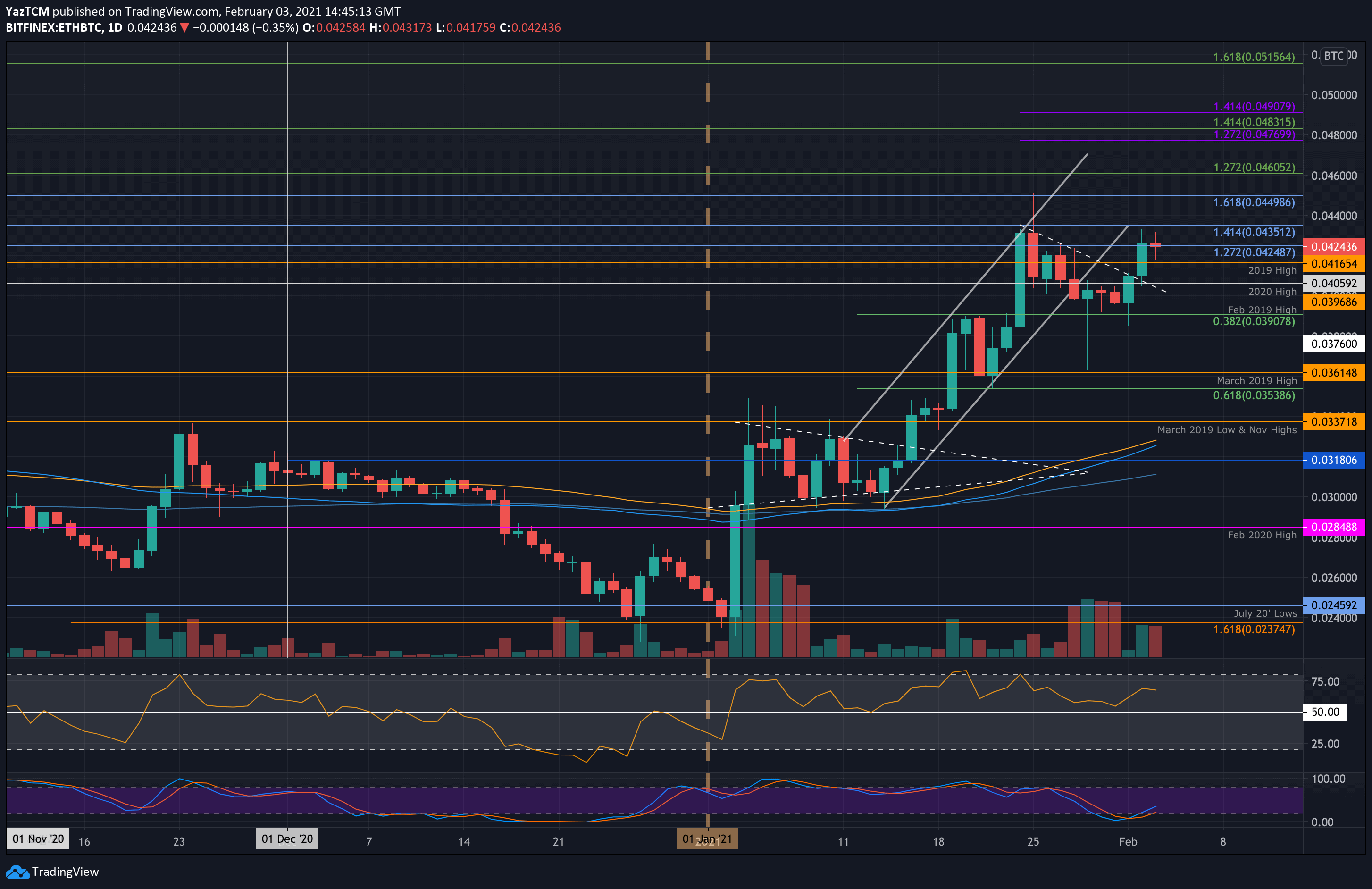
ETH/BTC – Bulls Eyeball 2021 Highs

Key Support Levels: 0.0416 BTC, 0.0405 BTC, 0.0396 BTC.

Key Resistance Levels: 0.0435 BTC, 0.044 BTC, 0.045 BTC.

Against Bitcoin, ETH is also trying to push higher after reaching 0.0435 BTC yesterday. It managed to penetrate a descending trend line as it surged beyond the 2019 highs to reach 0.0435 BTC.

Today, the cryptocurrency has dropped slightly, reaching as low as the 2019 highs again. However, it has since bounced as it trades around 0.0424 BTC.

ethbtc-feb3
ETH/BTC Daily Chart. Source: TradingView

ETH-BTC Short Term Price Prediction

Looking ahead, the first level of resistance lies at 0.0435 BTC. This is followed by 0.044 BTC, 0.045 BTC (1.618 Fib Extension), 0.046 BTC, and 0.0477 BTC.

On the other side, support lies at 0.0416 BTC (2019 high). This is followed by 0.0405 BTC (2020 high), 0.0396 BTC (Feb 2019 High), and 0.039 BTC (.382 Fib).

The RSI is also in the bullish territory as it remains above the midline. It still has much room before the momentum is overbought, indicating ETH/BTC has room to travel higher.

Title: Ethereum Price Analysis: After Breaking $1500, Those Are The Next Possible Targets For ETH
Sourced From: cryptopotato.com/ethereum-price-analysis-after-breaking-1500-those-are-the-next-possible-targets-for-eth/
Published Date: Wed, 03 Feb 2021 12:15:25 +0000

2021's Most Anticipated Growth & Wealth-Building Opportunity

Join Thousands of Early Adopters Just Like You Who Want to Grow Capital and Truly Understand Cryptocurrency Together


Ethereum Rate Analysis: After Breaking $1500, Those Are The Next Possible Targets For ETH
Check out the latest news at NewsWireUnited.com

Late on crypto? Organizations still at early phase of Bitcoin adoption

Late on crypto? Organizations still at early phase of Bitcoin adoption

Institutional investors are seen to be rushing toward Bitcoin (BTC) at high speed, with more companies emerging that look to adopt Bitcoin as a way to store their reserves. Recently, Marathon Patent Group, a Nevada-based Bitcoin mining company, has bought $150 million worth of Bitcoin as a reserve asset, a move similar to MicroStrategy purchasing $425 million worth of Bitcoin in September 2020. This purchase made Marathon Patent Group the third-largest holder of BTC among publicly traded companies

In addition to Marathon, BlackRock, the world’s largest asset manager by virtue of assets under management, has stated in its new filings to the United States Securities and Exchange Commission that Bitcoin derivatives now could be a part of the investment schemes of two of its associate funds, BlackRock Global Allocation Fund Inc. and BlackRock Funds. This is bound to set a precedent for other large asset management companies, such as Vanguard, UBS Group, State Street Advisors, etc., to enter into the domain of crypto investments.

According to research done by technology researcher Kevin Rooke, publicly traded companies now hold over $3.6 billion worth of Bitcoin, which is a 400% increase within the last 12 months. In 2019, these companies barely had 20,000 BTC in their portfolios, a number that has now jumped to 105,837 BTC, with the biggest holders being MicroStrategy, Galaxy Digital and Marathon Patent Group. Institutions are now getting involved in the Bitcoin market as some are expecting Bitcoin to become a digital alternative to gold.

2020 BTC bull run brings FOMO to institutional investors

The price of Bitcoin has jumped from around the $7,250 mark at the start of 2020 to its all-time high of $41,940 on Jan. 9 this year. This jump entailed that investors got a 303% return on their investment in Bitcoin over 2020. These returns surpassed the returns of market indicators such as S&P 500, Nasdaq Composite Index and gold by a significant margin.

These abnormally high returns with Bitcoin have led institutional investors to feel fear-of-missing-out, especially since several prominent traditional finance firms have tipped that Bitcoin could hit $100,000 later this year. Scott Freeman, co-founder and partner at JST Capital — a firm specializing in digital assets for institutional investors — told Cointelegraph that “BTC is more broadly recognized as an asset in its own right,” adding: “Funds that missed out on the growth in 2020 are being pushed by their investors to get exposure to this asset.”

In addition to the high returns that Bitcoin and other cryptocurrencies have offered throughout 2020 and continuing into 2021, institutional investors are looking to use Bitcoin to hedge risks from other assets on their portfolios that have a low correlation to the cryptocurrency markets.

Sergey Zhdanov, chief operating officer and chief financial officer of EXMO — a U.K.-based crypto exchange — told Cointelegraph that “cryptocurrencies have a higher practical value compared to gold.” He further pointed out that this “confirms the fact that cryptocurrencies have a chance to develop their applied characteristics (means of payment and circulation) and not only investment ones.”

An instance of institutions using Bitcoin as a hedge for their portfolios is when Ruffer Investment Company announced to its investors that it now holds 2.5% of its portfolio in BTC, stating that “we see this as a small but potent insurance policy against the continuing devaluation of the world’s major currencies.”

Still early adopters or laggards?

With a lot of institutions now buying Bitcoin and other cryptocurrency assets, one could argue that these investors are slightly late to the party and are buying assets at a higher price point than they would if they had adopted the crypto realm merely a year ago. However, Simon Peters, market analyst at eToro — a social trading and multi-asset brokerage company — told Cointelegraph:

“The institutions buying Bitcoin now and holding it as a reserve strategy can still be considered early adopters in a corporate sense. In the coming months and years, investors will look back at the start of 2021 as an opportune moment to get into crypto. Early adopters are opening the playing field for others to join.”

Buying and holding Bitcoin as a reserve currency for their portfolios to complement traditional assets is only the first step to widespread exposure. As these institutions become more familiar with digital assets, they will delve into other ways of utilizing them, such as for payments, remittance and settlement purposes, according to Peters, who added: “We may even see central banks holding Bitcoin if it grows in status to become a global reserve digital currency.”

Earlier this month, eToro released its “Institutional Cryptoasset Trading” report, which shows that one of the greatest barriers to institutional adoption of crypto is the insufficient market capitalization. However, now that the market capitalization has passed $1 trillion, the traditional players coming in are expected to accelerate the growth to $2 trillion in the near future. Peters further outlined how the new incoming administration in the United States responds to crypto will be critical:

“In the world of regulation, the new U.S. administration — including the arrival of a new Treasury Secretary, Head of the OCC, SEC Chairman and CFTC chair — could dramatically affect the evolution of the crypto market and how it links with traditional markets.”

Is the market still reacting to institutional buying?

The market is currently making institutional investors join the market as they are being pushed by their clients who want exposure to this fast-growing asset class. But these investors buying into Bitcoin is not really affecting the price action of the market in the current scenario, as that’s what is expected of them acting as somewhat of a lag indicator for these markets. Thus, it’s questionable whether these investments are actually pushing the market forward.

However, Zhdanov thinks that in the long term, these investments will push the market, as large investors tend to hold on to their positions. Furthermore, the number of new BTC addresses created daily still hasn’t reached the 2017 level, suggesting that the current growth is organic in nature. Freeman added that the entry of these players could benefit the volatility of these assets: “These investors tend to have a longer investment horizon and will tend to counterbalance the short-term volatility that may be caused by typically shorter-term retail investors.”

It’s important to remember that the BTC market is still more speculative than one that follows rules of traditional trading based on the fundamentals and technical analysis. The most recent example of this is Elon Musk, who added #Bitcoin to his bio with a related tweet saying: “In retrospect, it was inevitable.” 

Related: Institutional demand for crypto isn’t subsiding, but impact will be gradual

Bitcoin price responded with a surge that was later labeled as the “Elon Candle,” wherein it jumped by 13.9% within the next 30 minutes. This by itself is evidence of how speculative the market is at the moment. However, irrespective of these short term price movements, it is expected that more institutional investors will flock to the crypto markets for the lucrative gains, hedging opportunities and exposure they offer to diversified portfolios, albeit at a slower pace than many would like to believe.

Title: Late on crypto? Institutions still at early stage of Bitcoin adoption
Sourced From: cointelegraph.com/news/late-on-crypto-institutions-still-at-early-stage-of-bitcoin-adoption
Published Date: Wed, 03 Feb 2021 16:17:34 +0000

2021's Most Anticipated Growth & Wealth-Building Opportunity

Join Thousands of Early Adopters Just Like You Who Want to Grow Capital and Truly Understand Cryptocurrency Together


Late on crypto? Organizations still at early phase of Bitcoin adoption
Check out the latest news at NewsWireUnited.com

Expanding Your Investment Options: 403b to Gold IRA Rollover

Gold as a Safe Haven: 403b to Gold IRA Rollover Rolling over your 403b retirement savings plan into a precious metals IRA can offer several ...